
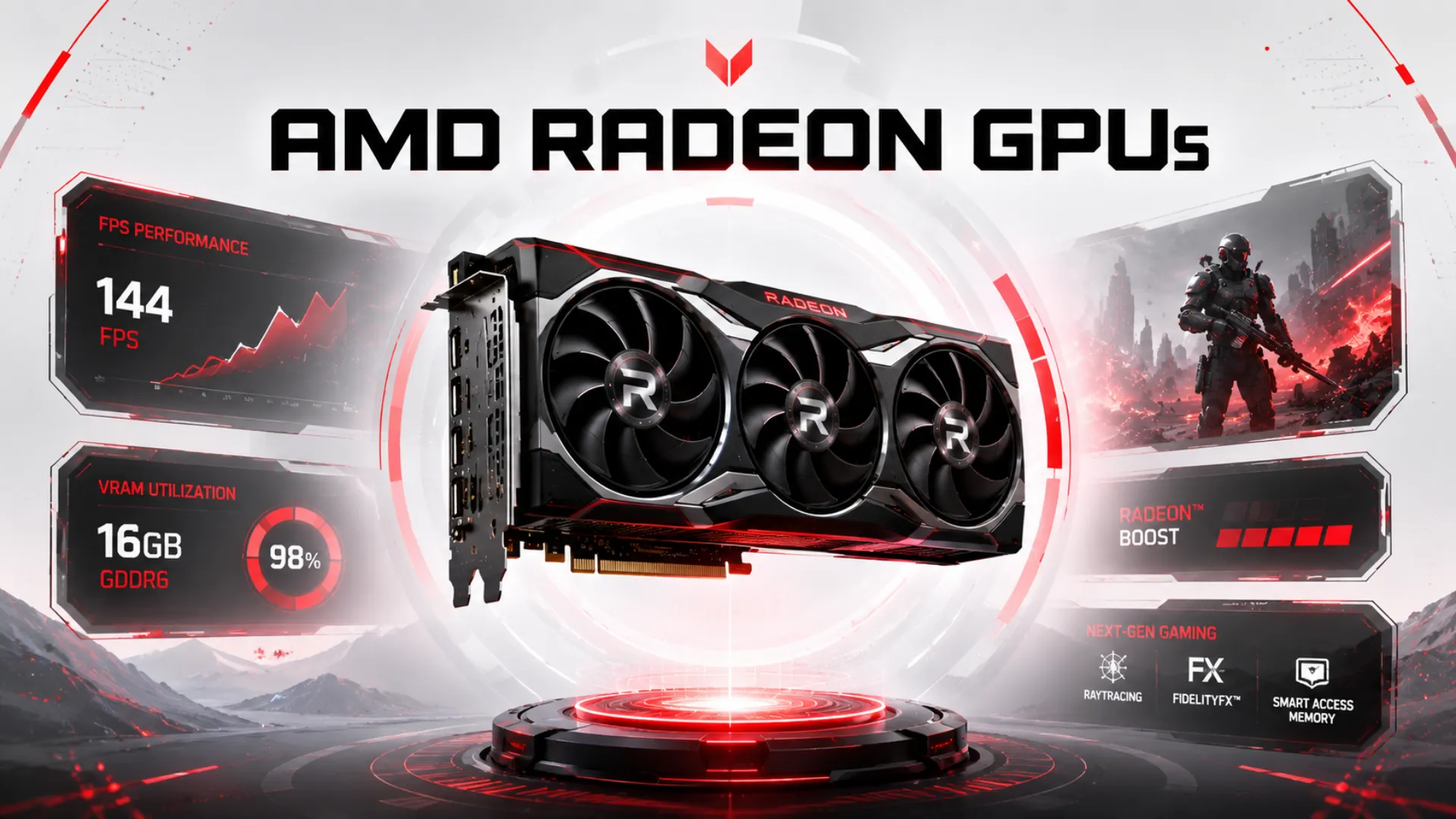
AMD Radeon GPUs Explained (The RX Lineup Made Simple)
AMD Radeon GPUs are known for strong value, generous memory, and solid gaming performance, which makes them a favorite for budget and mainstream builds. But the Radeon RX lineup, with its numbers and features, can be confusing at first.
This guide makes it simple. You will understand the Radeon RX families, what the numbers and features mean, how Radeon compares to Nvidia, and how to pick and pair the right AMD graphics card. By the end, the whole Radeon range will make sense.
Understanding the AMD Radeon GPU Lineup
Radeon is AMD’s brand of graphics cards, and current models carry the RX label. Like other graphics cards, the lineup is split into generations and tiers, and once you know the pattern, every name makes sense.

AMD names its cards with a series followed by a tier. Take the RX 9070 XT:
- RX is the Radeon gaming family.
- 9070 combines the generation and tier. The first part shows the generation, and higher is newer, so the 9000 series is newer than the 7000 and 6000 series.
- XT is a suffix meaning a faster version of that card.
So an RX 9070 XT is a current-generation, upper mid-range card, while an RX 6600 is an older, mainstream model.
What Do the Radeon Tiers Mean?
Within each generation, the tier number tells you the power level. Here is the simple guide.
| Tier (the xx60, xx70…) | Think Of It As | Best For |
|---|---|---|
| xx500 and below | Entry level | Budget 1080p gaming. |
| xx600 | Mainstream value | Solid 1080p and entry 1440p. |
| xx700 | Upper mid-range | Strong 1440p gaming. |
| xx800 and xx900 | High-end | High-refresh 1440p and 4K. |
An “XT” or “XTX” added to a name means a faster version, with XTX sitting above XT at the top of a generation.
What Makes Radeon Cards Stand Out
Radeon cards have a few clear strengths that draw gamers to them:
- Generous VRAM. Radeon cards often include more memory than similarly priced rivals, which helps at higher resolutions and with heavy textures, and keeps a card useful for longer.
- Strong value. AMD usually offers more raw frames per dollar, especially in standard gaming without heavy ray tracing.
- FSR upscaling. AMD’s FidelityFX Super Resolution boosts your frame rate by upscaling, and it works across a wide range of cards, not just AMD ones.
- Improving ray tracing. The latest Radeon generation has closed much of the gap in ray tracing performance with its rivals.

These strengths are why Radeon is often the value pick, particularly for gamers who care more about raw frames than maximum ray tracing.
Which AMD Radeon GPU Should You Buy?
The right Radeon card depends on your resolution and budget. Rather than repeat our picks here, we have chosen the best AMD cards in our focused guides:
- For top gaming picks by budget and resolution, see our best GPU for gaming guide.
- For the best cards in every category, see our best GPUs roundup.
- For the full how-to-choose, our GPU buying guide walks you through it.
- To see how Radeon cards rank against each other and against Nvidia, check the GPU hierarchy.
How to Pair a Radeon GPU With Your CPU
Any Radeon card works with any modern processor, whether AMD or Intel. The goal is balance, so your card and processor match in power. A budget Radeon card does not need a top processor, and a high-end RX card deserves a strong one, like a good gaming chip. If you pair it with an Intel chip, our guide to Intel Core CPUs explains that lineup, and for the best gaming chip to match, see our best CPU for gaming guide or, on a budget, our budget and cheap CPUs picks.

To get the balance right, drop your Radeon card and processor into our bottleneck calculator, check if the card is the limit with the GPU bottleneck calculator, or whether the processor is, with the CPU bottleneck calculator. You can also learn to check your PC bottleneck yourself.
How Radeon Compares to Nvidia
Many buyers weigh Radeon against Nvidia GeForce. Both make excellent cards, so it comes down to what you value. Radeon often gives more VRAM and better value at each price for raw frames, while Nvidia leads in ray tracing and DLSS upscaling. Neither is a wrong choice, so let your resolution and budget decide. To understand the other side, see our guide to Nvidia GeForce GPUs, to weigh two specific cards use our GPU comparison guide, and if you are new to graphics cards, start with what is a GPU.

Frequently Asked Questions
What does RX mean in AMD Radeon GPUs?
RX is the label for AMD’s Radeon gaming graphics cards. A name like RX 9070 XT combines the generation and tier, with a suffix like XT or XTX marking a faster version of that card.
What is the difference between Radeon RX 6000, 7000, and 9000 series?
The number is the generation, and higher is newer. The 9000 series is the newest with the latest features and best ray tracing, the 7000 series is the previous generation, and the 6000 series is older but still capable.
What does XT or XTX mean on a Radeon card?
XT means a faster version of that card, and XTX sits above XT at the top of a generation. So an RX 9070 XT is faster than a standard RX 9070.
Are AMD Radeon cards good for gaming?
Yes. Radeon cards are known for strong value and generous VRAM, making them excellent for 1080p and 1440p gaming. The latest generation also handles 4K and ray tracing well.
Can I use a Radeon GPU with an Intel processor?
Yes. A Radeon graphics card works perfectly with any modern processor, Intel or AMD. The CPU and graphics card brands do not need to match.
What is FSR?
FSR, or FidelityFX Super Resolution, is AMD’s upscaling technology. It boosts your frame rate by rendering at a lower resolution and scaling up, and it works across a wide range of cards, not just AMD ones.


