
Check If Your CPU and GPU Are a Good Match
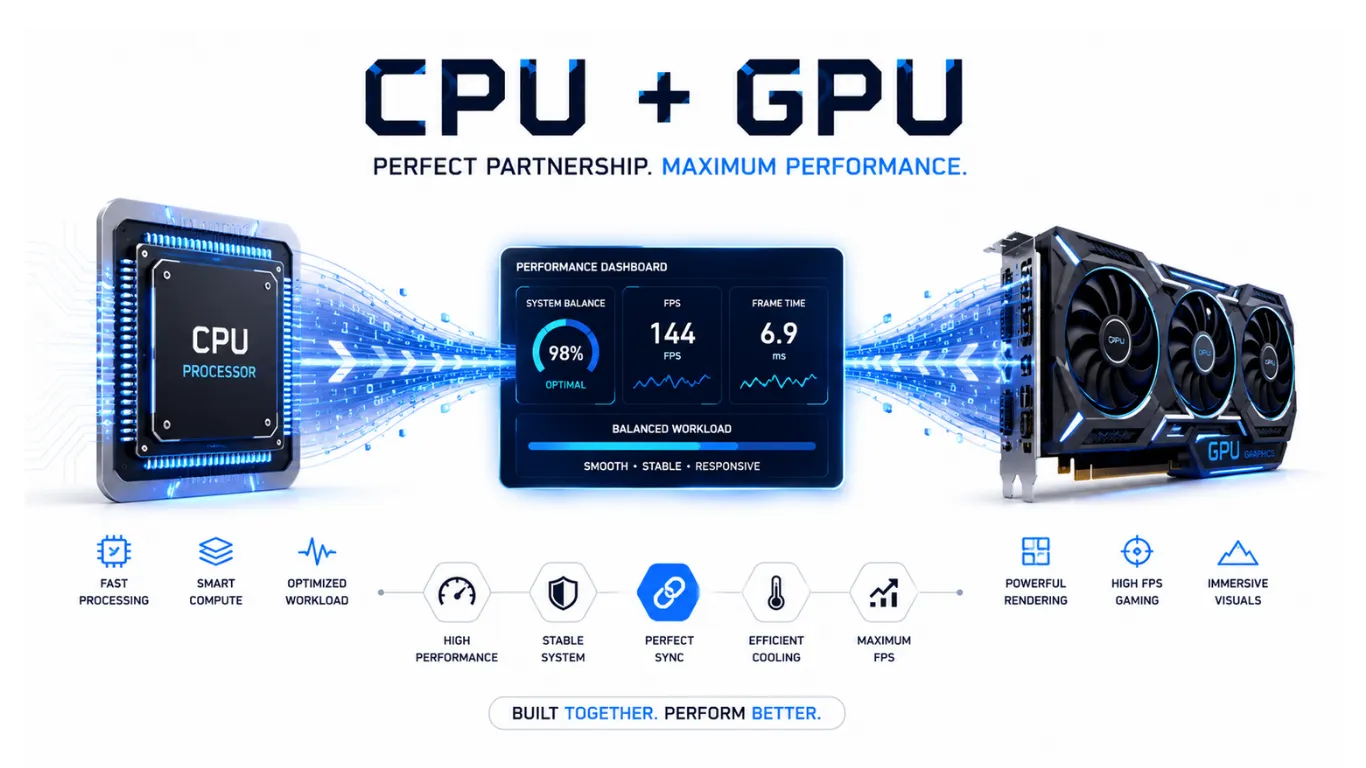
Your processor and graphics card are the two parts that decide your frame rate, and they have to work as a pair. If one is much stronger than the other, the weaker part holds the whole system back and you lose frames you paid for.
BOTTLENECK CALCULATOR
Detect CPU, GPU & RAM bottlenecks · 400+ components · Free & Accurate
Your Build Breakdown
Upgrade Recommendations
This free CPU and GPU bottleneck calculator checks both parts together, tells you which one is the limit, and shows you how big the gap is. Pick your processor, pick your graphics card, and get a clear answer in seconds. No sign up and no download needed.
[Run the calculator above to check your CPU and GPU pairing now.]
Why Your CPU and GPU Matter Most?
A PC has many parts, but two of them set your frame rate above all others: the processor (CPU) and the graphics card (GPU). The processor prepares each frame and the graphics card draws it. They pass work back and forth many times every second. When they are matched, that hand-off is smooth. When they are not, the slower part keeps the faster one waiting.

That waiting is the bottleneck. This is why checking your CPU and GPU together tells you far more than looking at either part alone. If the idea is new to you, our guide on what a PC bottleneck is and why it happens covers the basics first.
How to Use the CPU and GPU Bottleneck Calculator?
The tool is quick and works the same on a phone or a desktop. Here is all you do.

Step 1: Choose your CPU
Type your processor name in the CPU box and pick it from the list, like Ryzen 5 5600X or Intel Core i5. Not sure which chip you have? Open your system settings and look under device specifications.
Step 2: Choose your GPU
Do the same in the GPU box for your graphics card. The list stays current with over 400 parts, including new cards like the RTX 5070 Ti, RX 9060 XT 16GB, and RX 9070 XT.
Step 3: Set resolution and workload, then calculate
Pick your resolution and what you mainly do, then press the button. You get a percentage, a plain verdict, and which part is the weak link.
How to Read Your CPU and GPU Result
Your result names the part that is holding you back and shows how big the gap is. Here is how to read it.

| Result | Which Part Is Weak | What To Do |
|---|---|---|
| CPU bottleneck shown | Your processor cannot feed the graphics card fast enough. | A faster CPU or higher resolution helps most. |
| GPU bottleneck shown | Your graphics card cannot keep up with the visuals. | A stronger GPU or lower settings helps most. |
| Low percentage (under 10%) | Neither. Your pairing is well matched. | Nothing. Your CPU and GPU work well together. |
| High percentage (over 25%) | The named part is clearly holding the other back. | Plan to upgrade the weak part first. |
Want to know which numbers count as safe? Our guide on acceptable bottleneck percentage breaks down every range.
CPU Bottleneck vs GPU Bottleneck
A CPU bottleneck means your processor is the slow part, so your graphics card waits and your frame rate drops even though the card has more to give. A GPU bottleneck is the reverse, where the processor is ready but the card cannot draw fast enough.

This matters for your wallet. Upgrading your graphics card does nothing for a CPU bottleneck, and a faster processor does nothing for a GPU bottleneck. The calculator names the weak side for you, so you spend on the right part the first time.
Does RAM Affect Your CPU and GPU?
Yes, memory plays a supporting role. If your RAM is too small or too slow, it can drag down both your processor and graphics card and add stutter, even when the two main parts are matched well. That is why this tool also factors in your memory. If a result points at memory as a problem, our how much RAM you need guide helps you pick the right size and speed.
What About the Motherboard?
This is a common question, so here is the honest answer. Your motherboard connects your parts, but it does not cause a frame-rate bottleneck the way your processor and graphics card do. As long as your motherboard supports your CPU and GPU, it is not the thing slowing your frames. That is why this calculator focuses on the parts that actually move your FPS, your CPU, GPU, and memory.
Common CPU and GPU Pairings
People often ask if a popular combo is balanced. Here are a few examples to show how matching works. Always run your own exact parts in the tool, since resolution and workload change the result.
| Example Pairing | Typical Verdict | Best Use |
|---|---|---|
| Mid CPU with mid GPU | Well matched | Great all-rounder for 1080p and 1440p. |
| Older CPU with new high-end GPU | CPU bottleneck likely | Move to 4K, or upgrade the processor. |
| New strong CPU with budget GPU | GPU bottleneck likely | Fine at 1080p, upgrade GPU for higher settings. |
| High-end CPU with high-end GPU | Well matched | Built for 4K and heavy workloads. |
How Accurate Is This CPU and GPU Bottleneck Calculator?
Here is the straight answer, since trust matters. No tool can promise an exact frame count for your room, your settings, and your game. What this calculator does is compare your processor and graphics card using real benchmark scores, then weigh them against your resolution and workload. That gives you an honest read on which part is the weak link and how big the gap is.
Use it as a smart planning guide before you buy a part, not as a stopwatch. It is the right way to answer “should I upgrade, and which part first?” without wasting money on the wrong upgrade.

How to Fix a CPU or GPU Bottleneck
Once you know the weak side, the fix is clear. Start with the free moves, then upgrade if needed.
- Shift the load with resolution. Go higher to lean on the GPU, lower to lean on the CPU.
- Tune settings that hammer the weak part, like draw distance for the CPU or textures for the GPU.
- If the graphics card is the weak side, see our best graphics cards for gaming.
- If the processor is the weak side, check the CPU performance hierarchy to find a better match.
Changed a part in your plan? Run the new pairing in the tool and watch the gap shrink before you spend a dime. For a full system view across every part, use the main bottleneck calculator on our homepage.
Frequently Asked Questions
What is a CPU and GPU bottleneck?
It is when your processor and graphics card are not matched, so one waits on the other and you lose frames. The slower of the two sets the limit for your whole system.
How do I check my CPU and GPU bottleneck?
Pick your processor and graphics card in the calculator above, set your resolution and workload, and press the button. You get a percentage and the name of the weak part.
Can I use this calculator for a laptop?
Yes. Choose your laptop’s processor and graphics card from the list. Laptop parts often run a bit slower than desktop versions, so treat the result as a close guide.
Which is worse, a CPU or GPU bottleneck?
Neither is worse on its own. What matters is the size of the gap and which part you can upgrade. The calculator tells you which side to fix first.
Does the motherboard cause a bottleneck?
No, not for frame rate. As long as your motherboard supports your parts, it does not slow your FPS. The CPU, GPU, and memory are what matter.
Is this CPU and GPU bottleneck calculator accurate?
It gives an honest, benchmark-based estimate of which part is the weak link and how big the gap is. It is built for planning upgrades, not for promising an exact frame count.
Similar Posts
How to Check PC Bottleneck: Easy 2026 Guide
How to Check If Your PC Has a Bottleneck If your PC feels slower than it should, there is a simple way to find out why. Learning how to check PC bottleneck shows you whether…
What Is Counted As Acceptable Bottleneck Percentage? 2026 Guide
What Counts as a Good Bottleneck Percentage on Your PC? You ran the numbers and got a result from the bottleneck calculator, but now you are stuck on the real question: is that number good…
CPU Bottleneck Calculator: Check and Fix It 2026
Is Your Processor Holding Back Your PC? Find Out and Fix It A slow processor is one of the most common reasons a powerful graphics card never reaches its full speed. When your CPU cannot…
RAM Bottleneck Calculator: Free Memory Check 2026
Is Your Memory Slowing You Down? Check With the RAM Bottleneck Calculator Most people only think about their processor and graphics card, but memory can quietly hold a PC back too. If your RAM is…
GPU Bottleneck Calculator: Check and Fix It 2026
Is Your Graphics Card the Weak Link? Check and Fix a GPU Bottleneck When your graphics card cannot keep up with the rest of your PC, your frame rate drops and your games feel less…
What Is a PC Bottleneck? Simple Guide for 2026
PC Bottlenecks Explained: What They Are and Why They Slow You Down? So what is a PC bottleneck, really? In plain words, a bottleneck is when one part of your computer is too slow to…


